The Birth of a Field
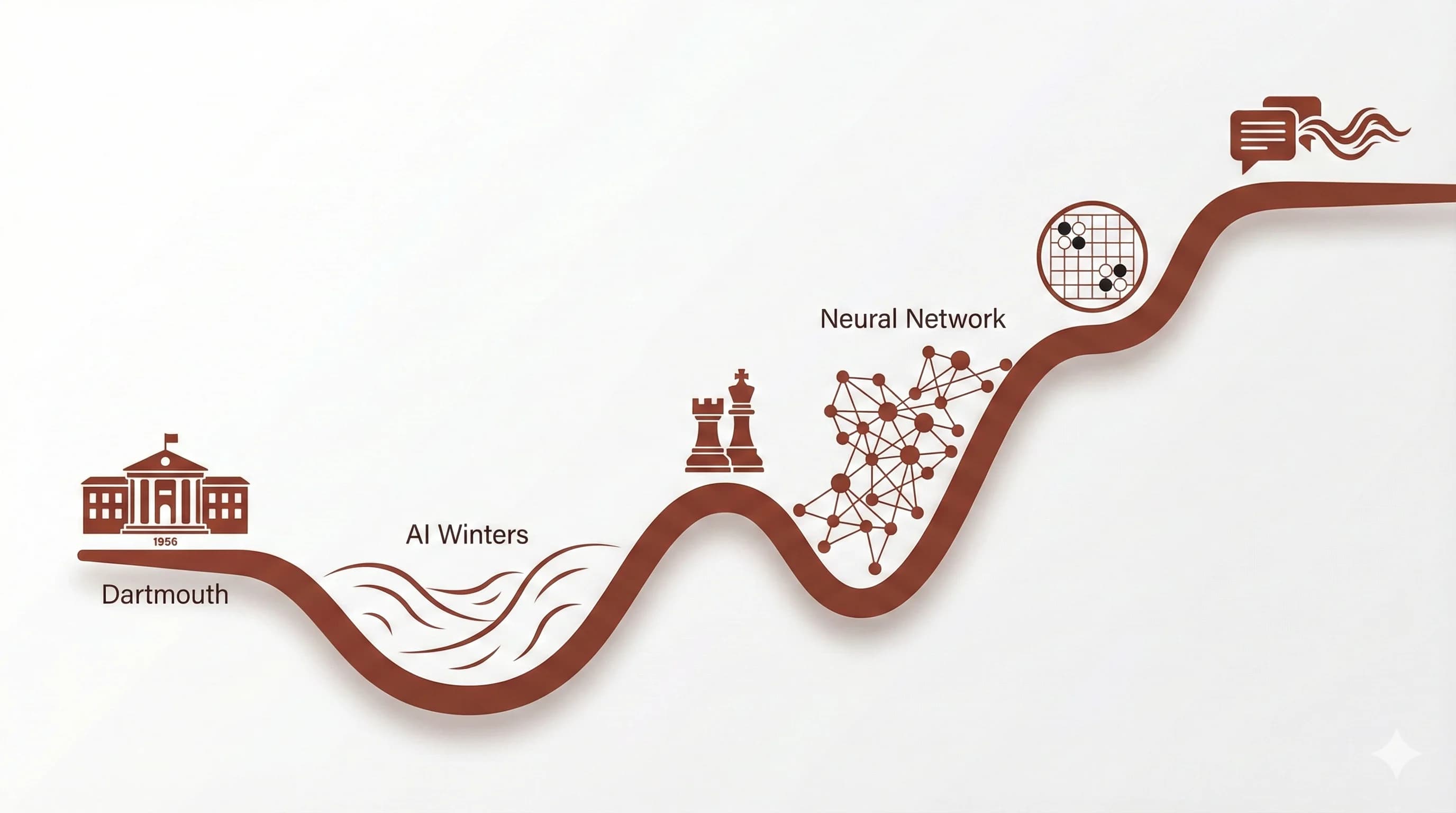
In the summer of 1956, a small group of researchers gathered at Dartmouth College with an ambitious proposal: to create machines that think. The Dartmouth Workshop coined the term artificial intelligence and launched a field that would transform the world—though not as quickly as those pioneers imagined.
The early researchers were optimists. They believed human-level AI was perhaps twenty years away. This pattern of overconfidence followed by disappointment would repeat throughout AI history.
Winters and Summers
The 1970s brought the first AI Winter. The Lighthill Report of 1973 devastated British AI research funding. Projects had promised too much and delivered too little. The gap between ambition and achievement led governments and corporations to pull back.
But research continued in pockets. And in 1997, IBM's Deep Blue defeated world chess champion Garry Kasparov. The victory proved machines could match human expertise in specific domains, even if general intelligence remained elusive.
The Deep Learning Revolution
The 2010s changed everything. AlphaGo's 2016 victory over Go champion Lee Sedol stunned the world. Go was supposed to be too intuitive, too creative for brute-force computation. Deep learning proved otherwise.
The subsequent explosion of capabilities has been remarkable. Image recognition surpassed human performance. Language models learned to write, code, and reason. Each year brought capabilities that would have seemed like science fiction a decade earlier.
The ChatGPT Moment
The November 2022 release of ChatGPT marked a cultural turning point. For the first time, anyone could have a sophisticated conversation with an AI. The technology left the research lab and entered everyday life.
This democratization creates unprecedented governance challenges. We are no longer governing experiments in research labs. We are governing systems used by hundreds of millions of people daily.
Lessons for Governance
AI history teaches us to be skeptical of both hype and dismissal. Progress comes in fits and starts. Systems that seem limited today may transform tomorrow. Conversely, promised breakthroughs may take decades longer than predicted.
Effective governance must be adaptive. It must be robust to uncertainty about future capabilities while addressing the real risks of current systems. The history of AI winters reminds us that backlash against overpromising can set back genuine progress.
KEY LEARNINGS
- The 1956 Dartmouth Workshop launched AI as a formal field with optimistic but unrealistic timelines.
- AI Winters occurred when inflated expectations met disappointing results, causing funding to collapse.
- Deep Blue (1997) and AlphaGo (2016) demonstrated AI mastery in narrow domains once thought impossible.
- ChatGPT (2022) democratized AI access, shifting governance from lab experiments to mass deployment.
- Effective governance must balance current risks against uncertain future capabilities.
- 🌐Dartmouth AI Conference: The Next Fifty YearsDartmouth's retrospective on the founding conference.
- 🌐Computer History Museum: AI TimelineInteractive timeline of AI milestones.
- 🎥DeepMind: AlphaGo DocumentaryDocumentary on the historic Go match.
- McCarthy, J., et al. (1955). A Proposal for the Dartmouth Summer Research Project on Artificial Intelligence.
- Lighthill, J. (1973). Artificial Intelligence: A General Survey. Science Research Council.
- Silver, D., et al. (2017). Mastering the game of Go without human knowledge. Nature.